Thursday, May 2, 2024

Also-Ran

Thursday, May 2, 2024

"Also-ran" means,  a contestant in a race who fails to win or to place among the first three finishers, or an athlete or team whose performance in competition is rarely, if ever, a winning or near-winning one. (Thanks, dictionary.com) That sounds a lot like Muroran.

Muroran (pop. 76,00) is a port on the south coast of Hokkaido. According to TripAdvisor, the number one thing to "do" in Muroran is the Hakucho Bridge. It's a big bridge. Okay, and . . .?


On a previous visit to Muroran we took an excursion to the Valley of Hell + a Ninja Show. The Valley of Hell was an active geothermal site, similar to places we have seen in Iceland and New Zealand. I have not seen any other Ninja shows to compare the one we saw in Muroran with, but it seemed a little amateurish. So we didn't want to go on that tour again, and there weren't any other tours that urgently required our presence, so we decided we would just walk around the center of town.

Yet another group of cute pre-schoolers appeared on the dock to wave at our ship

All day long people from Muroran showed up at the dock to see our ship. We had a great view of all the action from our balcony - people from our ship as well as people from town, with a few food trucks thrown in. 

We were docked some distance away so we had to take a shuttle into town. 

 
We got off at the JR Station with no idea where we were in relation to the town center or what we would see there - very unlike our usual style of travel.

Our lack of research was not such a smart move. We got off at a JR station, but it was not the main Muroran station. I think it was one for the east side of Muroran. How would we have known? That's where the shuttle stopped, though it did have another stop.

At the station there was a large map showing different walking routes to points of interest. We picked one and started walking, hoping there would be some level of wayfinding to guide us along. There wasn't. 

After two or three blocks we came to a major intersection. There was no indication as to which way we should go. Not only that, it was impossible to cross the street in any direction without climbing up and over a monstrous structure that dominated the intersection. At ground level, the curbs were all completely fenced off. You were forced to go up.


The photos really don't do this thing justice. It was huge. It covered a huge amount of real estate with all of its ramps and staircases and supports. It went completely around the intersection. Once you got up there, you could see that all four corners were connected by these raised walkways.

We climbed up grudgingly, and kept going in the direction we had been going in, toward a large store on the far corner. The one thing that the store had to recommend it was access directly from the elevated walkway. Well, boy howdy, we should go in right up here, we said.

The store was roughly similar to a Walmart, but without the greeters. They sold a little bit of this and a little of that. There were groceries and a large drug store on the street level,  and furniture on level 2, where we entered. Level 3 had crafts and clothes, housewares and knick-knacks.

Ken bought 3 mini-windsocks on a stick and I bought some washi tape. We also bought a lot of snacks (for the crossing) at the grocery store. (Did I mention that our final port, Kushiro, had been canceled, so this was to be our last stop before Whittier?)

I bought some shampoo and conditioner at the drug store because I didn't like the kind supplied by Princess. The drug store offered an overwhelming variety of hair products (with the exception of products for curly hair). It was interesting to see that most of the toiletries were sold in more sustainable packaging. Considering that Muroran has got to be at the tail end of the supply chain, this makes a lot of sense. I didn't really notice what they were selling in Tokyo, though.

This is roughly 12 ounces of hair conditioner              


By the way, it says "Filled with firmness - even wavy hair is tidied up."  I love shopping in Japan.

After looking at everything in the store, we realized that by the time we got back to the JR Station, there could be a long line for the shuttle bus, and it might already be full with folks who boarded at the other stop. We had lost interest in continuing our walking tour, especially if there could be more of those gruesome intersections, so we headed back to the JR Station to wait for our shuttle. The transit company had posted a couple of people at the bus stop to make sure everybody got on the right shuttle and we all made it back to the ship without incident.

Today’s fabric is Beige Traditional Japanese Fabric, 100% cotton, sold on Etsy by AsianFabrics.


Wednesday, May 1, 2024

Fort Squid

Wednesday, May 1, 2024

Its mascot is a squid and its nickname is Squid City. It is the third biggest city on the island of Hokkaido and was once the most important port in northern Japan. It’s Hakodate!

Hakodate is strategically located to serve as the gateway to Hokkaido and can be reached by shinkansen via the Seikan Undersea Tunnel. Of course, it can also be reached by air, by ferry from Honshu, and by cruise ship.

Hakodate was opened to foreign trade in 1854, and there are many points of interest from that period, including warehouses, consulates, churches, and neighborhoods built in the western style to house foreigners.

There is so much to see and do in and around Hakodate, that one could easily spend four days/three nights here.

Fish Market

We started out at the Fish Market. It is a jumble of buildings and stalls and hole-in-the-wall restaurants. You can buy fresh fish, vacuum-packed fish, dried fish, and all kinds of fish roe. Of course, there was a lot f squid on display. It is even possible to catch your own squid in a big tank.

This guy tried to climb out of his tank

Salmon

Some kind of dried fish

Various kinds of roe

Plastic models of menu items in the window of a restaurant 

Ready-to-eat corn-on-the-cob

Dried squid

A boy reels in a squid from the fish tank.
We did not have permission to take this picture, so I blacked out the boy’s face.

Goryōkaku

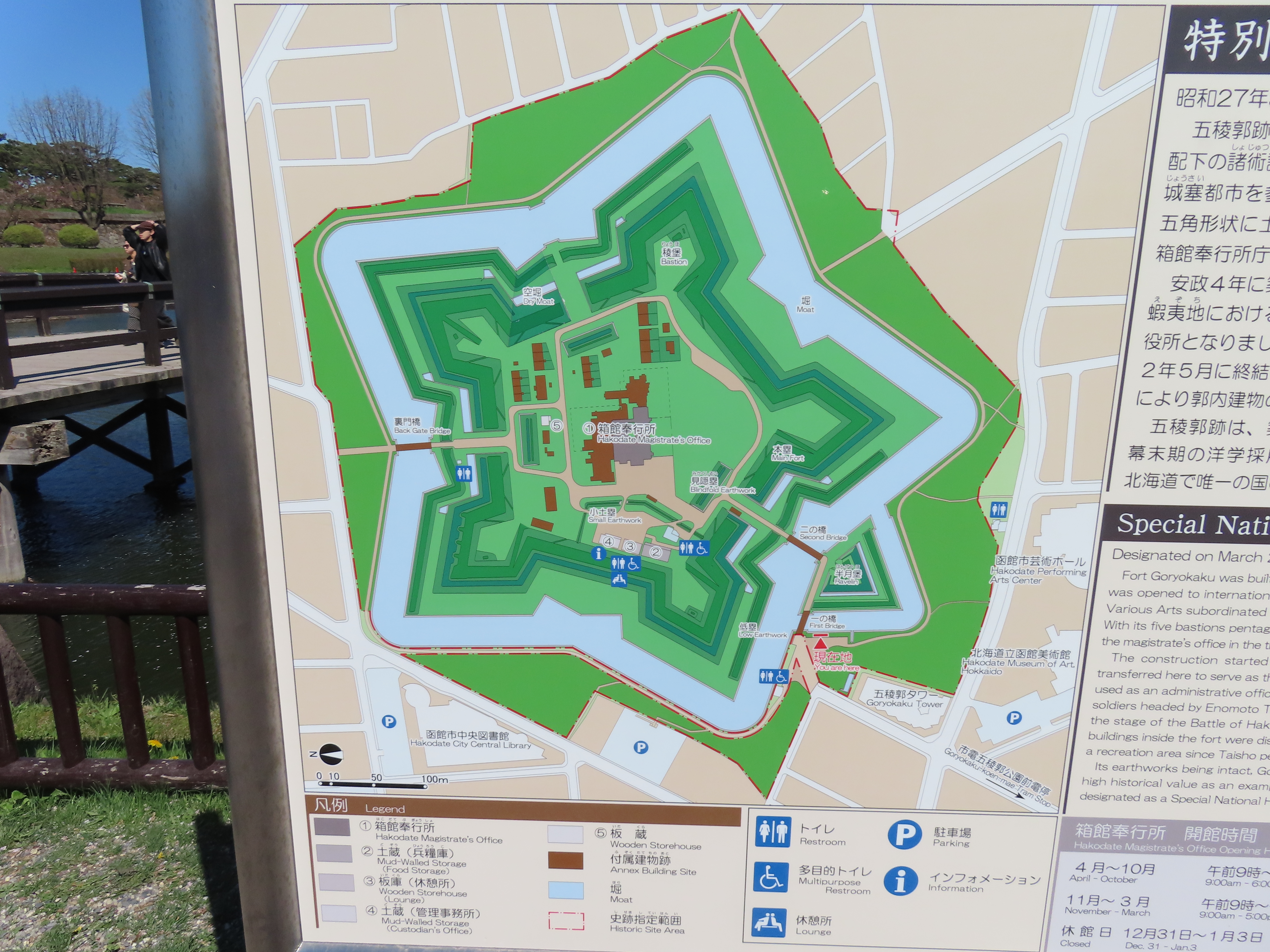
Goryōkaku started out as a fort, built by the Tokugawa shogunate and completed in 1866. Its distinctive star-shaped design was based on the work of a French architect. The five-pointed star allowed for more gun emplacements and fewer blind spots for cannon. But Goryōkaku has become a beloved park and is now a Special Place of Scenic Beauty and a Special Historical Site.

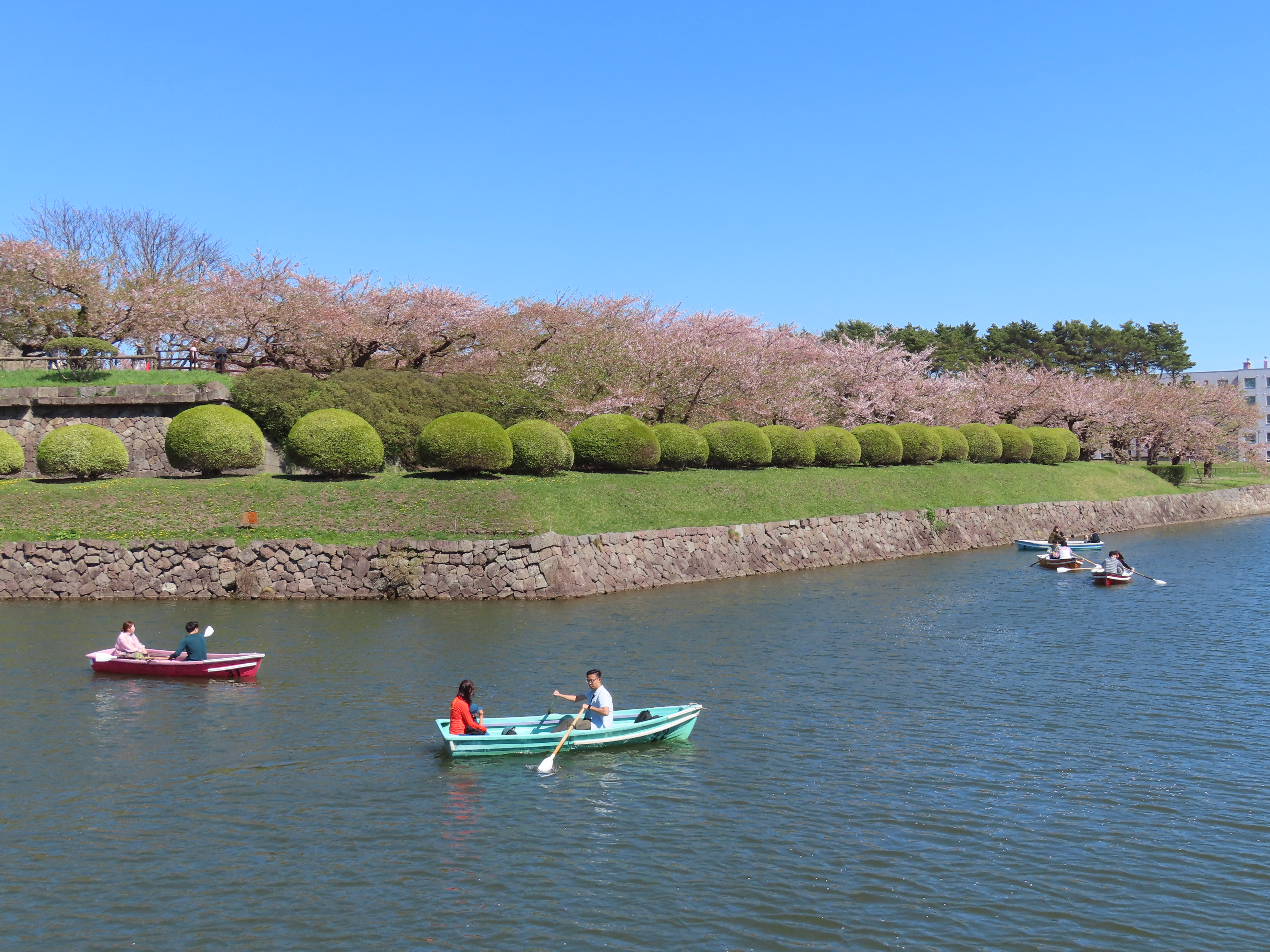
Because spring arrived in Japan a little bit on the late side this year, we were fortunate to catch the end of Hakodate’s cherry blossom season. We were treated to a spectacular show under a bright blue sky at Goryōkaku. 


Frrom the top of Goryōkaku Tower you can see the star shape of the fort below.
Carp streamers fly from the side of the tower to mark Golden Week.

Cherry blossom petals cover the ground


Folkloric Show

Back on the ship we were able to enjoy a folkloric show by a group called Yosakoi Soran. The show was excellent, especially the amazing solos by the man who played the samisen.


Today’s fabric is Large Ghostly Squid Damask by pattysloniger for Spoonflower. Damask is a woven, reversible, patterned fabric. I am not sure what makes this fabric a damask, as the design is printed on quilting cotton which does not usually have a pattern woven in. The fabric is part of a “Damask Collection,” which may have been given that name because the designs resemble the style of designs that were used in traditional damask weaving. The designer has skillfully brought out the beauty of a quite hideous creature.


Tuesday, April 30, 2024

That’s Aomori

Tuesday, April 30, 2024 

Aomori,  population 265,000, is the capital of the northernmost prefecture on Honshu, and it is a Winter City. Spring hasn’t really arrived here yet, though the snow is gone. The architecture says “winter”: the A-frame buildings, the roofs with snow-guards, the drabness, the buildings huddled together and low to the ground.  I could feel it, even if I couldn’t put my finger on how I knew there were serious winters here.

We arrived on a chilly, rainy day. A pre-school class came to look at our ship and welcome us. I don’t think Aomori gets a lot of cruise ships, either.


The economy of Aomori is principally driven by the service sector, with some manufacturing adding to the mix. Agriculture and commercial fishing are a distant third and fourth. However, the Aomori prefecture is the main apple-growing region of Japan. 

ASPAM

The shuttle from the port dropped us off at ASPAM (Aomori Prefectural Center for Industry and Tourism).
Photo of ASPAM from Aomori-tourism.com
ASPAM turned out to be a large A-shaped building with local farm products, souvenirs, and crafts for sale on the extensive ground floor. Believe it or not, the building was modeled after the “A” in Aomori. Upon entering the ASPAM building, you are immediately overcome by the irresistible smell of freshly baked apple pies. They were doing a land office business. You could buy the yummy, cinnamon-spiced pastries they called pies, or you could select a perfect-looking apple. Lots of A-words, if you speak English.
People from the ship were shopping like it was black Friday - there were so many interesting things for sale here. We were too mesmerized to remember to take pictures.

Wa-Rasse

From ASPAM it was just a short walk to the Nebuta Museum, “Wa-Rasse.” The Nebuta Matsuri, or “summer lantern festival,” is Aomori’s most important festival, so it gets its own museum. The name of the museum, Wa-Rasse, is hard to understand. It was selected by a public vote. The “wa” refers to laughter and also to the “bonds” that are formed between people who are involved in the Nebuta Festival, while the “rasse” refers to the festival’s chant: “Rasse, rasse, rassera.” I don’t know what rasse means, but I learned the chant from the guy pictured here, who gave a presentation while we were touring the museum.
He won 2nd place in the 2023 championships of the Nebuta Festival Dance Contest. The dance looks like you are jumping up and down on a pogo stick, but without the pogo stick. The guy had a tremendous amount of energy.

But, I am getting ahead of myself.


The Wa-Rasse is housed in a striking building, where the visitor can see several of the enormous floats that have been made during the year for the Nebuta Festival Parades. During the Festival (August 2-7 every year), over 2 million people visit Aomori and participate in the boisterous dancing. (Where do they stay?)

Nebuta Museum Wa-Rasse

The floats are very large and heavy. They have two wheels and are pushed by teams of volunteers. They are made of paper, bamboo or wood, and wire, but the wooden undercarriages that support the floats make them extremely heavy. At one time candles were used to light the floats, but now small electrical lights are placed inside the floats. Grids of India ink are painted on the paper after it has been glued on. Finally, melted paraffin and colors are applied.

Tiny models at the entrance to the museum showed how the floats are transported. “Float” is clearly a misnomer. In no way do they “float.”

Rows and rows of people get underneath the float
and push it while they march along


(No more tiny models. The following photos are actual floats from past parades. Use the photos of the tiny models to get an idea of the scale.) 
It was fascinating to see the film clips of various artists who have created the floats in the past. An incredible amount of work goes into them and it takes a full year to complete the models. As far as I could tell, they depict scenes that from legends and myths that would be familiar to the local people. Many of the stories seem to feature monsters and heroes.


These are not floats, but charming little lanterns about 18 inches tall, lighting up
a dark corner of the necessarily dark museum


Shōwa Daibutsu 

Seiryu-Ji Temple is a bit out of town, but that’s why it’s so nice. We went there to see the Shōwa Daibutsu (Shōwa Giant Buddha), and we got a Buddha plus an amazing garden amid wonderful scenery. The temple is not very old - it was founded in 1982. The Daibutsu was built in 1984. It is the tallest seated Buddha in Japan, at 21 meters (nearly 69 feet). It is possible to go inside the statue and see how it is constructed, but we did not do so.

The temple and buddha are located in a forested tract on the side of a mountain. It is very peaceful and beautiful. The people there seemed very welcoming and kind. We especially appreciated their assistance in calling a cab for us when we were ready to leave.

Enjoy these photos from our visit.

The first two photos show the Japanese garden. The pamphlet  we received explains that stones, moss, and sand are used to represent the sea and life in harmony with nature. Isolated from noise, it is possible to immerse one’s self in an atmosphere conducive to peace and healing.


The five-story pagda is the fourth highest wooden pagoda in Japan. It reminds us of the five elements: earth, water, fire, wind, and sky.

These pinwheels are for unborn children to console their souls


Our first view of the Daibutsu emerges from the misty forest


Visitors have placed coins around the neck of this statue as an offering


It was a worthwhile visit. It was much less crowded than other temples we have visited, but beautiful and calming. No, I am not thinking of becoming a Buddhist.

Folkloric Show

“Rhythmic Reverberations” was performed onboard our ship by a local group called The Sansa Spectacular. It was exciting to see the dancers, drummers, and flute players from Aomori in their brilliant costumes. Most of them seemed to be high-school students.


Today’s fabric is this cheerful dobby cloth seen at ASPAM.