Friday, April 19, 2024

Momotarō, Schmomotarō

Friday, April 19, 2024

Momotarō
Okayama Prefecture is famous for the luscious white peaches grown here. Therefore, it is, perhaps, not surprising that there is a local folk hero known as Peach Boy. Peach Boy’s real name was Momotarō, and he was born out of a peach. He had three faithful friends who followed him everywhere - a talking Shiba Inu dog, monkey, and pheasant. When Momotarō grows up, he vanquishes some ogres. The Momotarō story teaches children values such as bravery, teamwork, and the power of good over evil. He also models kind-heartedness and care for his parents.
We will meet Momotarō again.
Momatarō and friends in front of Okayama Station

Miscellaneous
At the railroad station we saw this display promoting eggplants. They are now in season.

The following sign is an example of the excellent wayfinding that is provided in many parts of Japan.
Signs like this with “You are here” markings and lots of detail can be found on every block in Tokyo. This one is in Kurashiki.

When you park here, the green bar pops up, making it impossible to back out until you have paid.

One of the many beautiful manhole covers in Kurashiki - wisteria

Kurashiki
Kurashiki is 17 minutes from Okayama by train, and is a must-do excursion. A 10 to 15-minute walk from the train station brings you to Kurashiki Bikan Historical Quarter (KBHQ). This section of the city was once a famous merchant district, full of white-walled warehouses. A graceful canal, lined with willow trees, flows past traditional buildings that now house shops, restaurants, and museums. 


Kurashiki’s warehouses served as a distribution center for rice during the Edo Period (1603-1867). Rice from the warehouses was brought by canal to ocean-going vessels which conveyed the rice to Tokyo and other cities.

This area has been designated an Important Preservation District for Groups of Traditional Buildings. It was fascinating to see what Japan was like in the Edo Period. We all know about the Samurai, but the lives of merchants are less familiar to me.

The shops at KBHQ are fun to browse through. Rather than the usual tourist traps, the shops here sell locally made crafts such as the prized Bizen ware pottery from the nearby town of Imbe. I also learned that the region is a hotspot for high-end indigo-dyed denims and similar fabric. And washi tape was invented here! 


There are a number of small museums in the KBHQ. We visited the Kurashiki Museum of Folkcraft where we saw everyday items created by anonymous artists, including ceramics, lacquer, wood, and metal works. Pictures were not allowed inside.


The Toy Museum was a lot of fun.
These dolls are daruma. They have weighted bottoms so they always pop up after being pushed over.


Time for lunch and udon was on the menu.


Okay, now. Here’s where it gets weird. We went to the Momotarō Karakuri Museum. Peach Boy!
The Museum had several optical illusion displays. Most of them used mirrors, and most of them were not very original and not very new.


We had to walk through a rinky-dink “fun house” where there were black lights and blasts of air and spooky noises. Then we went through several rooms full of Momotarō memorabilia - toys, books, art, and more. Even a WWII propaganda film about Peach Boy. The museum was poorly maintained and needed some repairs and a new carpet. We couldn’t wait to get out.  This had to be one of the Three Cheesiest Museums in Japan.
White-walled buildings that used to be granaries lined the canal.

Katsu
We went back to Okayama and decided to go to a Katsu restaurant for dinner. Katsu is a breaded, fried cutlet, usually pork. The breading is panko. It traditionally comes with a bottomless bowl of finely sliced cabbage.


Katsu with egg

Katsu with curry

In many Japanese restaurants there wi be a metal or wood cylinder on each table. The bill will be placed inside.

Today’s fabric is Large | Peaches Branches by elena_amo for Spoonflower.

Shabbat shalom!

Thursday, April 18, 2024

A Noble Garden and Castle

Thursday, April 18, 2024

We took a morning train from Tokyo to Okayama. It was a bullet train, which is called Shinkansen in Japan. Shinkansen means “new main line.” The trains are very sleek and streamlined, and they travel at about 200 mph. It is a very smooth ride that does not at all seem to the rider to be moving fast. 

Why, hello, Kitty! (Seen on the track next to our Shinkansen)

Ready to blog on the Shinkansen

I bought some onigiri (rice balls) for lunch at the train station. They were fresh and cheap and deicious. The one that was wrapped in nori seaweed was very clever. The main part was wrapped in cellophane or some kind of plastic so it wouldn’t make the seaweed soggy. Then the nori was wrapped around the plastic and another layer of plastic was wrapped around that. There was a pull tab and   If you pulled it correctly it would pull out the inner layer of plastic leaving the nori wrapped around the rice.

Pulling the plastic off

Ready to eat

After checking into our hotel, we decided to take advantage of the nice weather by exploring Koraku-en Garden. It was a short bus ride away. The Garden takes up most of what is now an island in the Asahi River.

Koraku-en Garden is considered one of the Three Great Gardens of Japan. It has been designated as a Special Place of Scenic Beauty. The garden was constructed during the reign of a feudal lord named Ikeda Tsunamasa. Construction began in 1687 and was completed in 1700. The garden was intended to be a place where Ikeda could relax from his political duties. Over the years, succeeding lords added to and modified the garden. In 1884 the property was given to Okayama Prefecture and the garden was opened to the public.

The garden was designed using a principal called shakkei, or “borrowed scenery.” By incorporating mountains and other features into the views from within the garden, a greater sense of spaciousness can be achieved. 

Okayama Castle is part of the “borrowed scenery”

The garden was designed in the kaiyū, or “scenic promenade” style. Thanks to numerous paths, a visitor is presented with new views of lawns, ponds, streams, hills, and tea houses  at every turn.


Other noteworthy features of Koraku-en include fields planted with tea and rice, sakura (cherry blossoms) in the spring, plums, irises, azaleas, and an aviary for the majestic red-crowned crane. There is also an archery range in the garden, as well as a number of tea houses.

The cranes raised their bills and shrieked in unison while we watched. It was beautiful and eerie.

The most memorable feature is Yushinzan Hill. This artificial hill, 6 meters high, was built by Ikeda Tsunamasa’s son. Here are some views from the top of the hill.


From the garden we crossed a footbridge to go over to Okayama Castle. It is known as Crow castle because of its black lacquer finish. We didn’t go on but walked around the grounds to admire views of the castle from different angles. Twelve generations of the Ikeda clan were lords of this caste. The main tower saw completion in 1597. It was destroyed in 1945, but has been reconstructed based on drawings and photographs. It is smaller than Osaka Castle, and MUCH less crowded, but it is lovely.


Wow! The way the stones were pieced together to build the walls was mpressive.


We rode a vintage tram back to Okayama Station. It was full of high school kids who did not offer their seats to us or any of the other seniors who boarded at the stop near the castle. After stopping at our hotel, we wanderedover to the station to choose a dinner spot. There were so many options . . .

Dinner: Japanese-style hamburger

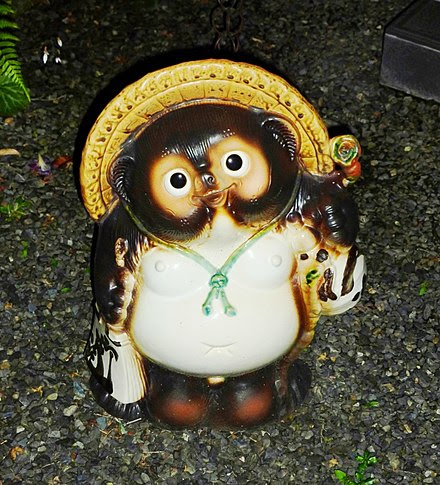
Today’s fabric is something that our mischievous friend Tanuki has inserted into my blog. This tanuki-themed cotton is a Japanese Indie fabric sold by modes4u.com.


Wednesday, April 17, 2024

The Tanuki Hunt Continues

Wednesday, April 17, 2024


We had been told we should look for a tanuki in Asakusa, so we decided to go there today. It would give us a chance to re-visit Senso-ji Temple, a site that we had not been to for quite a few years.

We took the subway and near the Asakusa exit we found a beautiful display behind glass in a niche in the underground passages.


I am thinking it is either a model of a palanquin that was once used in connection with Senso-ji Temple, or it is a model of a festival float. Asakusa is known for its festivals.

We arrived in Asakusa and realized that we didn’t know exactly where to look for our tanuki. 

First, let’s talk about tanuki. A tanuki is an animal that lives in Japan. It is real. In English it is called a”racoon dog.” It is neither a raccoon, nor a dog. It is a member of the fox and wolf families.

Photo from Wikipedia

Tanuki is also a well-known character in Japanese folklore. He is mischievous and jolly, and slightly supernatural. Little statues of Tanuki are ubiquitous, especially in front of restaurants and in gardens. He is thought to bring good luck. Usually Tanuki wears a straw hat and carries a lantern and a bottle of sake. Maybe he is a bit drunk.

Photo from Wikipedia

Tanuki really grows on you. After a few trips to Japan, I became a fan of Tanuki. I have been wanting one for a while, and this is a trip where carrying him home will not be a problem, so . . .

We decided to start our Asakusa Tanuki hunt on . . .  Wait for it.  . . . Tanuki Shopping Street.  

TSS turned out to be highly overrated. It was a narrow lane, two blocks long, and nearly forgotten. There were no Tanuki to be had here, and no shopping, for that matter. It wasn’t much of a street. The only Tanuki element that we encountered was a series of lanterns with weird metal tanuki in them.

Ma and Pa Tanuki?

This poster shows all of the Tanuki and where they are located on TSS

We decided that the guy at Don Quijote in Shinjuku might possibly have meant for us to look for tanuki at the Don Quijote in Asakusa. We bit the bullet and forayed into another Don Quijote, but there was nothing remotely as nice as a tanuki in the entire store. They did, however, have many flavors of Kit Kats.

We gave up and decided to go and see the Senso-ji Temple, which was two or three blocks away. It was hot and crowded, so we didn’t stay long.


On our way out through the maze of little shops surrounding Senso-ji, I suddenly spotted a couple of tanuki in a shop window. I was overjoyed! They had been so hard to find in Tokyo - they are more of a Kyoto item.

I picked out the smaller one. I liked his face better. I would have liked a larger one, but I was grateful to have the cute one I chose. The clerk carefully wrapped it up and put it init’s box and wrapped up the box and put the box in a bag and sealed up the bag. They are huge fans of wrapping things in Japan. So, MISSION ACCOMPLISHED, as W once said.

Sorry I don’t have a photo. Tanuki is all wrapped up. Maybe at a later point in the trip I will be able to unwrap him.

We schlepped back to our hotel with Tanuki and a bunch of melted Kit Kats. 

The view from our room, including some bright pink azalea beds

For our last night in Tokyo we decided to go to a revolving sushi bar. By mistake, we ended up at a “standing”’ sushi bar. Maybe some other time, but not after a week of marching all over Tokyo. Nope. We need a sitting sushi bar. Fortunately, there was one a block away. It was great, but we learned not to sit near the end of the conveyor belt. By the time it gets to you, there isn’t much to choose from. But we very much enjoyed it. It’s a fun way to eat.

Oishi!
Delicious!

No thank you

All done. You stack up your used plates and the price for each plate is determined by the color of the plate.

Today’s fabric is Tanuki Fabric, from F & P Interiors. It is a blend of linen, cotton, viscose, and polyester. It is described by F & P as a smart woven fabric with a mesmerizing diamond zig zag design. In traditional Japanese folklore, the Tanuki is a magical fox-like animal known for its mischievous nature and shape-shifting abilities.


I would totally buy that couch. It’s gorgeous.

Tuesday, April 16, 2024

National Treasures

Tuesday, April 16, 2024

We rode the subway to Omotesandō to visit the Nezu Museum. This ultra-modern building has a wonderful Japanese garden. Once again, we have encountered a large tract of wooded land hidden away in the heart of Tokyo. Amazing.

Nezu Museum has 7,400 works of Japanese and East Asian art, including calligraphy, sculpture, textiles, and ceramics. The Nezu’s collection includes seven National Treasures, 87 Important Cultural Properties and 94 Important Art Objects.

I would really like to do some research on the process of giving these designations to pieces of art. Who decides? What are the criteria? Is there ever any controversy over these decisions? What effect do the designations have on the public? Do people tend to skip over the non-designated items? Is that a good thing? 

I appreciate the help. I am not an art expert - not even close. I can’t possibly look at everything in a museum, or read the information about everything I look at. In a less structured way, I used guidebooks, rather than a government agency, to decide what to see in Italy. There’s just too much to digest. It is valuable to focus on what is considered important, but I would like to know more about why a particular piece of art is important. So, it seems like a good idea to create a hierarchy of art for the general public, but something about all the categories and levels of importance seems a little pretentious. Furthermore, if you have too many designations and categories, the importance of all of them gets watered down a bit.

I will admit that I LOVED the one National Treasure that was brought to my attention during this visit.

The first gallery we came to featured screens. We don’t use screens much today in the US. I’m not even sure they are used much today in Japan. But at one time they were everyday items.  Everyday items, I might add, that must have begged for an artist to come along and give them a little extra oomph.

Did I mention that we were not allowed to take photos inside the museum? So you are going to have to use your imagination, for the most part.

Now, among all these screens were two that I thought were spectacular. You can get a look at them at the website for the Nezu Museum. They appear in a group of scrolling pictures at the top of the home page. (For now. I expect that the museum will update its homepage at some point.)

The first screen I’d like you to notice is the one with the irises. This is actually a set of two six-panel screens, and these are a National Treasure of Japan. They were painted circa 1701-1705 by Ogata Kōrin. The artist painted on gold leaf, using only powdered azurite and malachite to make the blue and green pigments. I was surprised to see such a modern looking piece of art that dates from over 300 years ago. 

The second screen I would like to tell you about is the one on the Nezu’s homepage that looks like some quilts on a rack. It is actually kimonos on a rack, and it tells a story about a man, a courtesan, and a child. I think the title was something like “Whose Sleeves?”

We also saw some amazing bronze pieces, some as much as 3000 years old. Those are the things that really stood out, IMHO.

The garden of the Nezu was lovely.


We wandered around and came to a tea house where tea and sweets were being served. We decided to stop - we were hungry and ready to sit down. It was an interesting experience, but, once again, not what I was expecting. We had to sit on the front step and put our feet on a big rock in front of the entrance, and take our shoes off. Inside, people were kneeling on the floor. This was the Japanese style of kneeling, called seiza. (Click on the link to see what it looks like.) My knees were already swollen after all the walking and standing I had done, and it just wasn't going to happen for me. Fortunately, they did bring us chairs, but it was a little bit embarrassing to sit in chairs while most of the others were managing to kneel. 
We were not supposed to take pictures of other guests, so I blacked out their faces. You can see the back of a man in a black robe, kneeling and serving tea.


The people running the tea house seemed to be Buddhists. They performed some rituals while serving us matcha tea. We all got one “sweet,” called wagashi.

We took the train back and stopped at Don Quijote in Shinjuku to see if they had a certain item  wanted to buy. If you have never been to Don Quijote, this is what you need to know. It is a humongous, over-the-top store full of tacky souvenirs and cheap junk. An obnoxious theme song is constantly blaring and tourists are pushing and shoving to get in or out. 

The thing I wanted was a tanuki statue, and I would never go into Don Quijote unless I really wanted something and couldn’t find it anywhere else. We looked on all 5 floors and couldn’t find it. We couldn’t find anyone to ask. Finally I went to the check-out counter and asked a young lady. She didn’t know and asked someone else who said they didn’t have them but we should look in Asakusa. (To be continued)

We were glad to get back to the hotel.

Vibrant azaleas in front of our hotel

 After a short rest we went out for dinner to Ippudo, a ramen place near the hotel that we have visited several times on previous trips. Quick, cheap, and delicious.

Today’s fabric is kimono fabric. This is a bundle of vintage silk crepe de chine kimono fabric scraps, sold on Etsy by CircaFabrics.


Loose Ends:

There was a question in the Comments yesterday about how we knew what to order from the machine at the noodle place. One of the people who worked there gave us a card with English  corresponding to the buttons on the machine. Somebody was available to help you, if you needed it. There really weren’t very many choices: small or large, extra meat or extra vegetables. then there were a number of toppings that were extra. You pressed the buttons for your order and a screen showed your total. You put cash or a credit card in to pay and that was it. The cooks got the orders on a tablet.